Istituzionale IVECO
presentato da Motor Parts Industry ( MPI)
IVECO in Nigeria
Romano Pisciotti
Istituzionale IVECO
presentato da Motor Parts Industry ( MPI)
IVECO in Nigeria
Romano Pisciotti


The name Iveco first appeared in 1975 after a merger of Italian, French and German brands. Its production plants are in Europe, Brazil, Russia, Australia, Africa, Argentina and China, and it has approximately 5,000 points of sales and service in over 160 countries.


With over 28,000 employees, Iveco is present in all five continents: 27 plants located in 16 countries around the world manufacture vehicles with top level technologies developed in 6 research centres. Outside of Europe, the company operates in China, Russia, Australia and Latin America. An extensive after-sales service network guarantees our support in all geographic areas where an Iveco vehicle is at work.
The joint venture of Iveco, FPT Industrial and Nikola will produce electric and fuel cell trucks for the European market at Iveco’s headquarters in the German city of Ulm. The first trucks will roll off the assembly lines next year.
Nikola Tre, a truck designed for the European market, was presented in December 2019. Iveco, FPT Industrial and Nikola announced last week that the large electric vehicle would be made in Ulm, which is the home of the IVECO’s chassis engineering hub. The joint venture partners will invest 40 million euros in the modernization of the factory.
“The decision to build the Nikola TRE in Ulm – a centre of heavy-duty truck engineering excellence – underscores the site’s strategic location at the heart of Germany’s fuel cell technology cluster.”
Presented by Romano Pisciotti
https://www.iveco.com/corporate-en/pages/history.html
Presented by Romano Pisciotti
Motor Parts Industry (MPI)
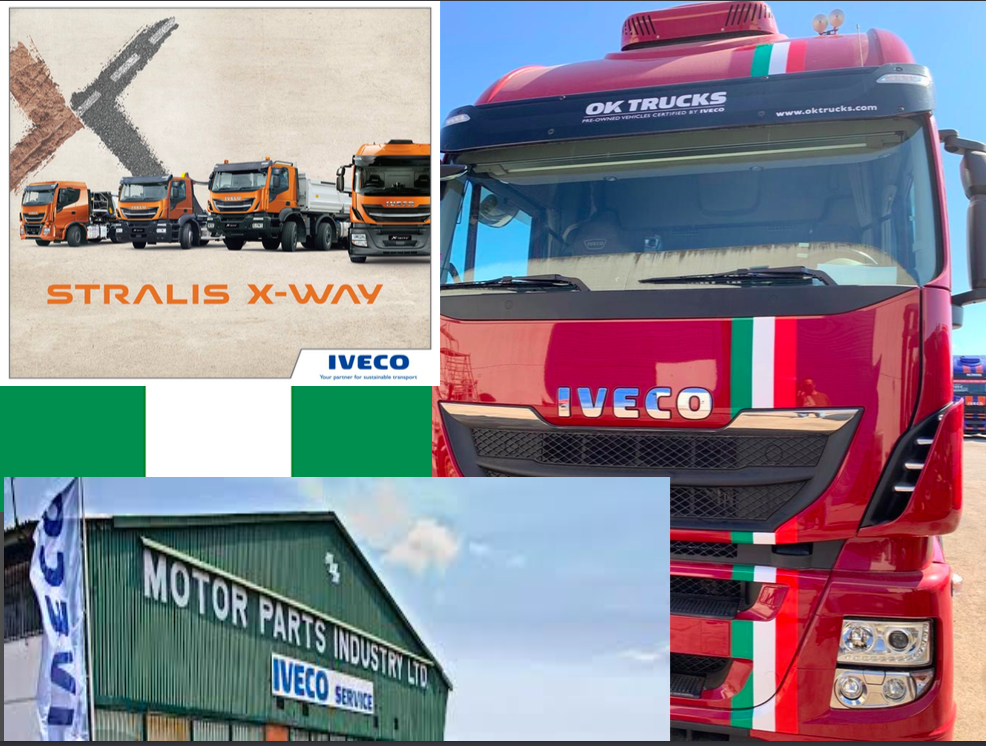
IVECO – Nigeria


The lower dependence on oil … which continues, however, to constitute a great wealth … the huge investments in agriculture and animal husbandry, the interest of investors in search of unsaturated markets, the protection of local industry … in a country that has the largest domestic market in all of Africa … will lead to the recovery of economic circulation.
The need for new markets will become a priority that will favor large emerging markets, such as Nigeria.



Romano Pisciotti
MPI – Motor Parts Industry
italmotor@gmail.com
WORKSHOP: 231 Moshood Abiola Way, Ijora (old APAPA Road)
P.O.Box 198 Apapa, Lagos – Nigeria.
These dangerous performances even for an expert “STUNTMAN”, are absolutely not recommended for a common pilot.
Queste esibizioni pericolose anche per uno “STUNT MAN” asperto, sono assolutamente sconsigliabili per un pilota comune.
Camion e Furgoni IVECO
Presentato da Romano Pisciotti
We realize and supply all the requested conversions as well for usual vehicles as for other types of transport…

We can equip them with:
We produce and transform in our own workshops vehicles into:


Romano Pisciotti
MPI ( Motor Parts Industry)
IVECO DEALER
italmotor@gmail.com
WORKSHOP: 231 Moshood Abiola Way, Ijora (old APAPA Road)
P.O.Box 198 Apapa, Lagos – Nigeria.

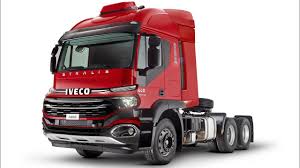
MOTOR PARTS INDUSTRY (MPI) is the largest stockist of original IVECO spare parts in Nigeria and has a fully equipped workshop where all IVECO vehicles can be repaired.


ROMANO PISCIOTTI
MPI
WORKSHOP: 231 Moshood Abiola Way, Ijora (old APAPA Road)
P.O.Box 198 Apapa, Lagos – Nigeria.
In ottime condizioni malgrado il passare degli anni…e sono veramente tanti
In excellent condition despite the passing of the years … and they are really many.

A CAREFUL MAINTENANCE IS THE SECRET

PHOTO BY ROMANO PISCIOTTI
Motor Parts Industry
IVCO – Lagos, Nigeria
London (February 6, 2020) — IVECO and FPT Industrial, the commercial vehicle and powertrain brands of CNH Industrial N.V. (NYSE: CNHI/ MI: CNHI), and Nikola Motor Company will manufacture, through their European Joint Venture, the Nikola TRE in Ulm, Germany, at the IVECO manufacturing facility.
This strategic and exclusive Heavy-Duty Truck partnership saw CNH Industrial taking a $250 million stake in Nikola as the lead Series D investor. The partnership announcement at the CNH Industrial Capital Markets Day in September 2019, was quickly followed in December with the unveiling of the Nikola TRE, a battery electric vehicle (BEV) heavy duty truck, which is the first step towards the fuel-cell electric (FCEV) model.
Today, the site in Ulm is IVECO’s chassis engineering hub, ideally situated at the heart of the Baden-Württemberg region, which is striving to become a leading hub for fuel-cell mobility thanks also to its skilled workforce and research labs. The region has committed a substantial investment to fund research and development projects in the area which has a strong automotive industry, with strategic project partnerships, meaning the Ulm facility will benefit from close proximity to key suppliers.
Furthermore, the German Federal Government recently released its draft National Hydrogen Strategy, which has the aim of expanding the pioneering role of Companies in hydrogen technologies. In this strategy, it commits a total of two billion euro to fund the hydrogen innovation programme, incl. the development of the necessary distribution infrastructure.
“Our European joint-venture with NIKOLA and today’s announcement, is real proof that zero-emission long-haul transport is becoming a reality, resulting in tangible environmental benefits for Europe’s long distance hauliers and its citizens,” said Hubertus Mühlhäuser, Chief Executive Officer, CNH Industrial. “The decision to build the Nikola TRE in Ulm – a center of heavy-duty truck engineering excellence – underscores the site’s strategic location at the heart of Germany’s fuel cell technology cluster.”
In the first stage of the project, €40 million will be invested by the joint-venture Company to upgrade the manufacturing facility, which will focus on final assembly of the vehicle. Start of production is anticipated within the first quarter of 2021, with deliveries of the Nikola TRE beginning in the same year.
“The Nikola TRE is proving to be the most advanced articulated truck in the world and will continue to set the standard for zero-emission vehicles today and in the future,” said Trevor Milton, Chief Executive Officer, Nikola Motor Company. “The decision to volume produce the TRE in the city of Ulm is a fitting example of how to create jobs, foster innovation, provide certainty to new zero-emission part suppliers and serve as an example to other OEM’s. The world is ready for zero-emission freight transportation, and the joint venture between Nikola and IVECO will be the first to deliver. I look forward to seeing the first production vehicles come off the line.”
The first models to enter production will be the battery-electric 4×2 and 6×2 articulated trucks with modular and scalable batteries with a capacity of up to 720 kWh and an electric powertrain that delivers up to 480 kW of continuous power output.
The Ulm facility will receive module supplies from IVECO´s manufacturing locations in Valladolid and Madrid, Spain, which will enable a rapid ramp up to meet expected customer demand. Fuel-cell electric versions, built on the same platform, will be tested under the EU-funded H2Haul project during 2021 for an expected market launch in 2023.
The Nikola TRE currently in development is based on the new IVECO S-WAY platform and integrates Nikola’s truck technology, controls and infotainment. Testing is expected to begin in mid-2020 with prototypes showcased at the IAA 2020 commercial vehicle exhibition in Hannover, Germany this September.
“By drawing on our Gold standard World Class Manufacturing sites in Madrid and Valladolid, Spain, where the IVECO S-Way is produced, we are able to accelerate final assembly, powertrain integration and high-end customization of the Nikola TRE for a timely market introduction in 2021” said Gerrit Marx, President Commercial and Speciality Vehicles, CNH Industrial.
This Joint Venture forms part of a wider partnership established with Nikola to accelerate industry transformation towards emission neutrality of Class 8 heavy-duty trucks in North America and Europe through the adoption of fuel-cell technology. The primary focus of the collaboration is to leverage each partners’ respective expertise to successfully deploy zero-emission heavy-duty trucks and to disrupt the industry with an entirely new business model.
INFO/Presented by Motor Parts Industry (IVECO – Lagos, Nigeria)
Romano Pisciotti